Mechanosensory logic of meiosis · Chromosome architecture · Quantitative biology & AI
Institute of Functional Biology and Genomics (IBFG) · CSIC / University of Salamanca
Chromosomes don't move by chance. During meiosis — the cell division that produces sperm and eggs — chromosomes must find their partners, exchange DNA, and separate with perfect fidelity. We want to understand how they do it, how they sense when something is wrong, and what happens when the system is pushed beyond its limits.
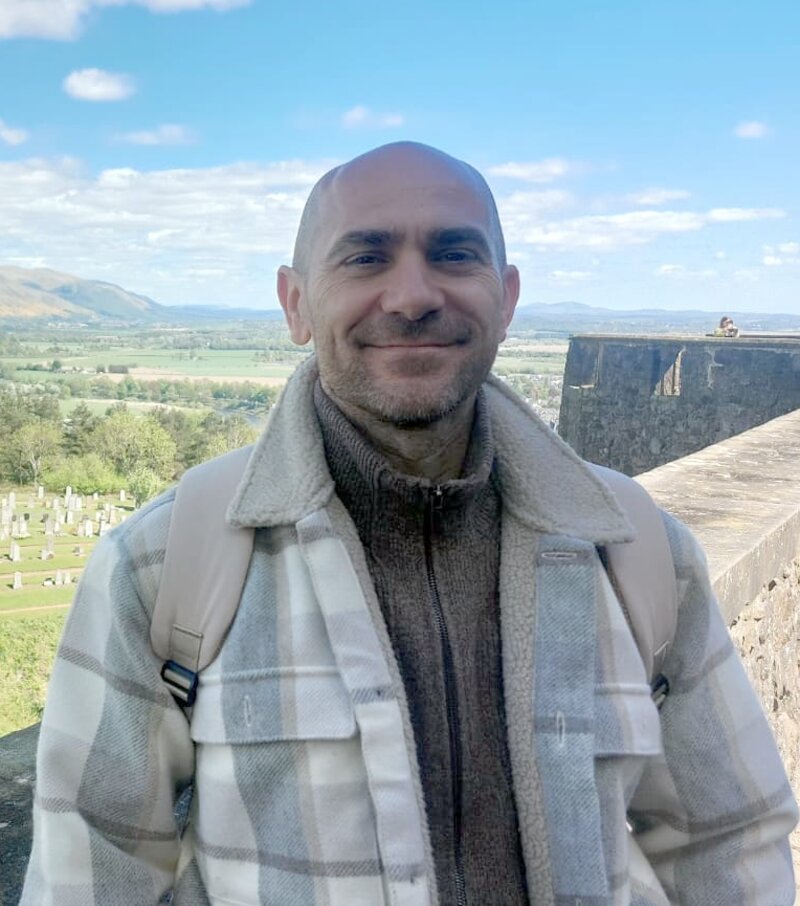
I am a Tenured Scientist (Científico Titular) at CSIC, leading the Nuclear Dynamics, Telomeres & Reproduction group at the Institute of Functional Biology and Genomics (IBFG, CSIC/USAL) in Salamanca, Spain. Our lab focuses on quantitative cell biology of meiotic chromosome dynamics, using fission yeast Schizosaccharomyces pombe as a primary model organism.
I obtained my PhD in Genetics (2011, cum laude, Extraordinary Award) from Universidad Pablo de Olavide, Seville, working on protein glycosylation in the plant pathogen Ustilago maydis. I then trained as an EMBO Long-Term Fellow at the London Research Institute (Cancer Research UK, 2011–2014) and as Senior Postdoc at the NIH (Bethesda, 2014–2018), in both cases in the lab of Dr. Julie Cooper, specialising in telomere biology and live-cell quantitative imaging. I returned to Spain in 2018 as a Ramón y Cajal Fellow at CABD (Seville) before joining IBFG as CSIC Tenured Scientist in December 2021.
A hallmark of my research is the integration of experimental cell biology with quantitative and computational approaches, including unsupervised machine-learning analysis of chromosome trajectories. This has led to the open-access platform ChroMo for automated analysis of chromosome dynamics.
Meiosis is not a fixed programme that runs the same way regardless of context. It is a state-sensitive system that integrates environmental conditions through physical interfaces, converts them into chromosomal architecture, and produces a probabilistic output of segregation fidelity. Our five research threads are the five layers of that single system.
During meiotic prophase the genome must reorganise into a functional state that enables homologue recognition and faithful recombination. We study how the telomere bouquet assembles, how centromere positioning orchestrates that assembly (Nature Communications 2025), and what defines the informational hierarchy within the chromosomal system itself.
ActiveTelomeres anchor to the LINC complex at the nuclear envelope to form the bouquet — a literal physical connection between the cytoskeleton and the genome. When the cell is under mechanical, nutritional or thermal stress, LINC mechanics change, and that change propagates directly to chromosomal architecture — no signalling cascade required. We are defining how this mechano-to-genome transduction works and what post-translational modifications gate it.
ActiveWhen the system cannot reach the canonical chromosomal state, it adopts alternative configurations — some functionally equivalent (adaptive plasticity), others that lead directly to segregation error. We study the interchangeability of telomere and centromere roles in meiotic spindle formation, the mechanistic basis of non-canonical bouquet states, and the conditions under which the system tips from resilience to failure.
ActiveThe meiotic spindle is the mechanical executor of chromosome segregation. Chromosomal acceleration towards the spindle pole is a precise biophysical readout of the entire upstream architecture: if the spatial state (bouquet, centromere positioning, LINC mechanics) was compromised, the acceleration signal reveals it. We measure it in live cells, model the forces involved, and map how perturbations in layers 1–3 propagate into measurable changes in spindle dynamics.
ActiveGiven the full stream of quantitative image data — trajectories, accelerations, spindle morphologies, spatial positions — an unsupervised ML model learns to classify whether a cell will segregate correctly, and which variable carries the most predictive weight. This makes the transfer function of meiotic fidelity measurable: a causal, quantitative map from environmental input to chromosomal outcome. ChroMo brings this pipeline to the entire community as an open-access tool.
ActiveThe quantitative layer of our research generated a tool the whole community can use. ChroMo is an open-access web application for unsupervised analysis of chromosome movement trajectories — no coding required. It applies the same machine-learning pipeline we use in the lab to any live-imaging dataset, promoting reproducibility and data reuse across cell biology labs worldwide.
Open ChroMoFull list of 24 peer-reviewed articles. # = corresponding author. Also available on PubMed, Google Scholar and ORCID.
We are a young, dynamic group at IBFG (CSIC/USAL) in Salamanca, combining experimental cell biology with quantitative and computational approaches.
Current Members
Alumni
Open to scientific collaborations, enquiries about our research, Master's and PhD projects, and postdoctoral applications.